

Innovation is often discussed in big, bold terms – but turning it into something real, scalable, and valuable is a very different challenge. For enterprises, and for the B2B or B2B2C vendors working with them, one of the most critical – and often underestimated – steps is getting the Proof of Value (PoV) right.
In a recent conversation with Oli Platt, Head of Client Services at NayaOne, we explored 10 key lessons he’s learned from running PoVs that truly move the needle – and pave the way for long-term impact.
Let’s Start with a Few Definitions: What Exactly Is a Proof-of-Value (PoV) - and Where Does It Fit?
Before diving into the lessons, it’s worth grounding ourselves in what a Proof of Value (PoV) really is – and where it fits within the broader innovation and procurement journey. A PoV isn’t just a demo or a trial run; it’s a focused, time-bound experiment designed to test whether a solution can solve a specific business problem in a real-world enterprise context. Done right, it bridges the gap between idea and implementation – helping stakeholders build confidence, align expectations, and make smarter decisions about what to scale.
A proof of value (PoV) sits before full development and before vendor commitment.
It’s the stage where you validate whether something is worth building or buying at all.
A quick refresher on how this process usually plays out:
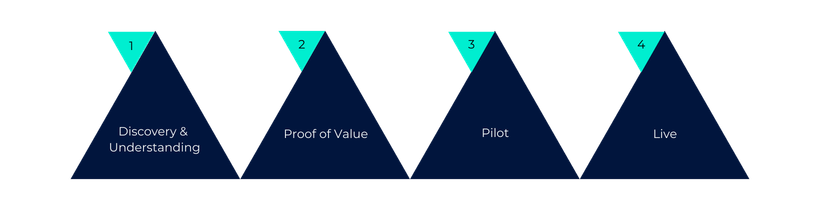
- Discovery & Understanding
This is where it begins. The vendor seeks to deeply understand the enterprise’s priorities and constraints. Meanwhile, the enterprise is evaluating whether the solution aligns with real needs – and whether it’s worth exploring further. - Proof of Value (PoV)
The PoV is about validation. You test shortlisted options in a controlled environment using realistic scenarios, data, and constraints. Can the solution work in the enterprise’s context? Will it deliver value within the organisation’s real-world constraints? Both sides are evaluation assumptions and assessing potential. - Pilot
If the PoV is successful, a pilot typically follows – integrating the solution into existing systems, with real users and live data. It’s about moving from theory to practice, from promise to performance. - Live
Once the pilot proves out, it’s time to scale. This is where full adoption happens: wider integration, enterprise-wide rollout, and long-term operational support.
Of course, there are critical supporting processes too – things like third-party risk management (TPRM), contracting, and onboarding. These can take 6 – 9 months, though timelines vary widely. For many of the enterprises we work with, TPRM comes after a PoV – saving time and focusing effort only when there’s proven value. For others, TPRM happens earlier, before the PoV kicks off.
Why Run a Proof-of-Value (PoV)?
Most teams don’t fail because the idea was wrong. They fail because they committed too early.
A proof of value slows that decision down just enough to test whether something actually works in your environment, with your data, under real constraints. It moves you away from demos and assumptions, and toward evidence.
This is where most organisations struggle. Running a PoV isn’t just a step in the lifecycle, it’s an execution problem. Getting access to the right vendors, setting up realistic environments, and evaluation against real use cases is harder than it sounds.
That’s why structured vendor delivery infrastructure matters. It gives teams a repeatable way to evaluate vendors against real use cases, not just features, before anything is committed.
Because the real issues only show up in execution. Performance drops, integration gets harder, and expected value doesn’t materialise. A PoV brings those risks forward, when they’re still manageable.
The cost of running a PoV is small. The cost of getting it wrong is not.
10 Lessons Oli Has Learnt from Running 100+ PoVs a Year
So, what sets a great PoV apart from one that fades into the background? In Oli’s experience, a few consistent factors make all the difference:
1. KPIs, KPIs, KPIs
No success metrics = no success. Every PoV needs a shared, measurable definition of what “good” looks like. Think of it like setting a GPS route – without a clear destination, it’s easy to get lost. Without clear KPIs, it’s impossible to know whether you’ve succeeded – or how to improve.
2. Map the Future User Journey
Understand where the solution fits in the real world: which systems feed into it, where the outputs go, and who’s actually using it day to day. A good PoV is grounded in workflow reality, not just technical theory. The closer the PoV reflects future usage, the easier it is to scale and adopt.
3. Use Case–Specific Data
Test with data that mirrors the real environment. Over-sanitised or irrelevant data might make the solution look good on paper, but it leads to false positives – and problems later. While real-world data is essential to capture edge cases, complexity, and practical constraints, synthetic data can be a powerful tool when real data is limited or sensitive. Used wisely, it helps simulate realistic scenarios and stress-test systems, especially in early stages.
4. Focus on What the Enterprise Actually Cares About
Is compute efficiency critical? Deployment model? Integration depth? UI performance? Don’t boil the ocean – align on what matters most for this specific use case and design the PoV accordingly. A targeted focus ensures limited resources go toward what will actually influence the decision.
5. Make Value Clear for Both Sides
Success should be defined jointly. Enterprises want to solve problems. Vendors want to prove value and move fast. Be clear on the pathway forward: who decides, when, and based on what.
When both sides are aligned, the process becomes faster, more focused, and more productive.
6. Get Broad Buy-In Early
Bring the right people to the table from day one – business, tech, security, architecture. If they’ll be involved in implementation later, include them in the conversation now. Early alignment avoids last-minute blockers and helps build internal momentum for scaling.
7. Let KPIs Evolve
PoVs are learning exercises. Be open to adjusting success metrics as the teams gain clarity around the use case, the constraints, and what success should actually look like. Flexibility enables the PoV to reflect real-world complexity – without losing rigour.
8. Tailor Outcomes to the Audience
Different stakeholders care about different things. Engineers want detail. Executives want business impact. Tailor your outputs accordingly – show value in a way that makes sense in their world. A technically perfect demo is wasted if the strategic value isn’t made visible to decision-makers.
9. Keep the Feedback Loop Open
A clear debrief is essential. Did the PoV hit the mark? Were expectations met? Was the value communicated clearly? Even if the result is a “no,” an open and honest wrap-up helps both sides walk away informed – and better prepared next time. It also shows professionalism and integrity – which vendors and enterprises both remember.
10. A “Failed” PoV Isn’t a Bad One
A PoV that doesn’t go live isn’t a failure. It’s a save – of time, money, and energy. It’s better to find misalignment early than to discover it mid-implementation. For vendors, that’s freedom to focus on better-fit opportunities. For enterprises, it avoids costly deployments and internal fallout. A clear “no” now is better than a painful “why did we do this?” later.

Whether you’re an enterprise exploring new solutions or a vendor trying to cut through the noise, the PoV is your proving ground. How you approach it matters.
With the right structure, clear KPIs, and open communication, a PoV becomes more than just a checkpoint in the sales cycle – it becomes the foundation for a long-term partnership, or a confident decision to step away.
Big thanks to Oli Platt, our Head of Client Services, for sharing real-world lessons from countless PoVs. If you’re navigating this process yourself, there’s a lot to learn from his perspective.