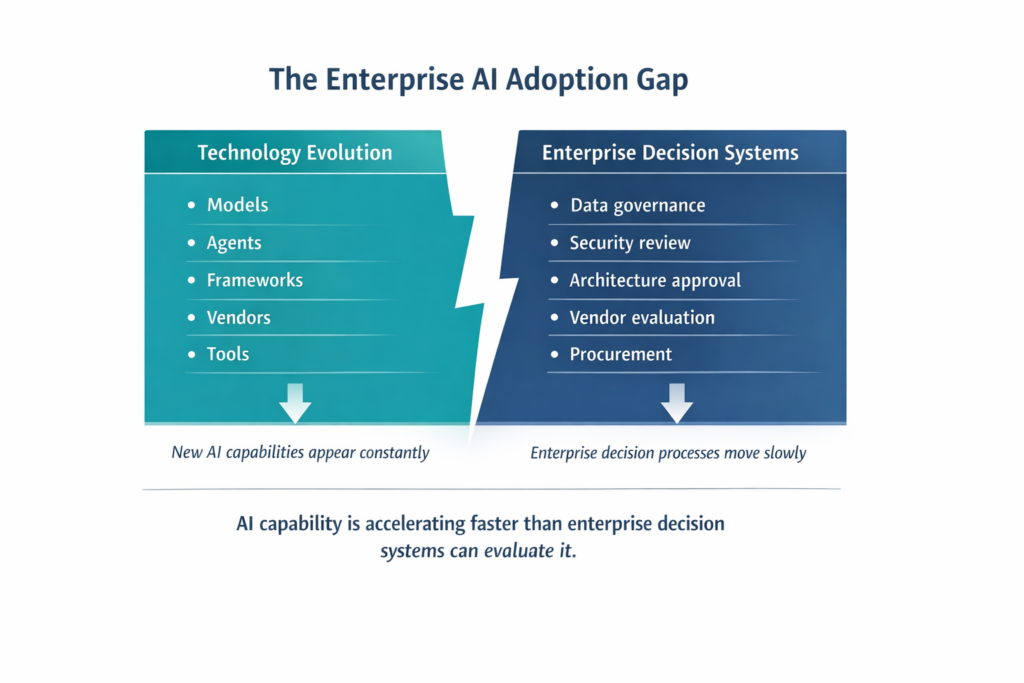
One of the striking features of the current moment in AI is the dramatic mismatch in speeds. New models and capabilities advance at a pace that would have seemed impossible even a few years ago. Yet when one looks inside large, regulated enterprises – particularly in financial services – the pace of meaningful adoption is far more deliberate. Most organisations are experimenting. Relatively few have moved to scaled, production-grade deployment.
This is not primarily a story about technological limitations. It is a story about the structural realities of how complex institutions absorb and trust new capabilities.
The Core Challenge Is Coordination Across Mandates
What we observe repeatedly is that promising AI initiatives must navigate a set of legitimate, independent organisational mandates before they can even be properly tested. Data teams need confidence in safe access and protection of information. Security teams must assess new vectors of risk. Enterprise architecture must ensure clean integration with existing systems. Procurement and legal functions evaluate vendor viability and commercial terms. Risk and compliance teams verify alignment with regulatory expectations.
Each of these reviews exists for sound reasons rooted in the responsibilities of regulated institutions. When these reviews occur sequentially rather than in parallel, however, the cumulative delay becomes substantial. The technology continues to evolve rapidly while the decision-making apparatus of the enterprise moves at a more measured cadence. The resulting gap is what we might call decision latency.
| Function | What they usually need to confirm |
|---|---|
| Data teams | How data will be accessed and protected |
| Security teams | Whether the architecture introduces new risk |
| Enterprise architecture | How the system integrates into the existing stack |
| Procurement | Vendor viability and commercial terms |
| Compliance and risk | Regulatory and governance requirements |
The Evaluation Infrastructure Gap
Large organisations have developed processes for operating production systems. Yet the upstream work of discovering, testing, and deciding on new technologies often still relies on ad-hoc mechanisms: shared documents, sequential committee reviews, and procurement processes originally designed for more static software. This creates a quiet but persistent inefficiency. Evaluation frequently moves far more slowly than the underlying technology itself.
Decision Latency as a Structural Tax
This mismatch imposes a real cost. Every additional week of evaluation consumes engineering time, cools vendor relationships, and carries opportunity cost as peers move ahead. Over time these small frictions compound. The organisations that manage to reduce decision latency – without compromising safety or governance – gain a compounding advantage.
The Particular Difficulty of Testing AI
AI introduces questions that traditional software did not. Creating realistic test environments without exposing live data, monitoring model behaviour in ways that satisfy both engineers and regulators, ensuring evaluations are repeatable and auditable – these are not artificial barriers. They are the natural consequences of operating in environments where errors can have material consequences.
Data and architecture teams sit at the centre of this tension. Their role is increasingly to enable experimentation that is both rapid and responsible, balancing the need for realistic access, strong governance, and reasonable speed.
| Function | Typical questions |
|---|---|
| Data teams | Can the tool access representative data safely? |
| Security teams | Does the architecture introduce new risk? |
| Enterprise architecture | How does the system integrate into the existing platform? |
| Procurement | Is the vendor approved to work with the organisation? |
| Compliance and risk | Does the evaluation meet regulatory requirements? |
The Organisations That Will Pull Ahead
In the long run, the institutions that distinguish themselves will not necessarily be those with access to the most advanced models. They will be the ones that have built the organisational capability to evaluate, validate, and integrate new AI systems with greater speed and confidence.
This capability is not about any single tool or platform. It is about creating clearer decision rights, better parallel evaluation processes, and infrastructure specifically designed for safe, rapid technology absorption in regulated settings.
The underlying technology will continue to accelerate. The question for every enterprise is whether its internal systems for learning and deciding can keep pace – responsibly and at scale.
We explore these patterns in more depth in our recent four-part conversation with Sanjay Sankolli of Truist, published by CDO Magazine. Part 1 is now live and addresses why even technically successful proofs of value often fail to reach production.
How Leading Enterprises Evaluate Emerging Technology
Many organisations are now utilising more structured environments specifically designed for the safe discovery, testing, and validation of new technologies before they reach production systems. These controlled environments allow teams to evaluate vendors, test integrations in realistic conditions, and gather credible evidence on performance, security, and risk – all while protecting live operations and sensitive data.
Capabilities of this kind are becoming one of the most important levers for closing the gap between rapid technological progress and responsible, large-scale enterprise adoption.
→ Learn how NayaOne helps enterprises evaluate AI and emerging technologies.