The pace of AI innovation is exhilarating – and unforgiving. New models, agents, and third-party tools appear weekly, each promising transformative capability for enterprises. Yet the very speed that excites us also creates a structural tension: organisations want to move fast, but traditional vendor onboarding, risk review, and integration processes were designed for an earlier era.
The result is a quiet bottleneck that quietly inflates costs, multiplies complexity, and slows genuine progress.
The responsible path to powerful AI is not to slow down innovation, but to build the right scaffolding around it. One of the most practical – and under-appreciated – pieces of that scaffolding is what we call an evaluation layer: a standardised, secure environment where AI capabilities can be tested, compared, and understood before any contract is signed or any system is integrated.
Think of it as a secure airlock between curiosity and commitment.
What the Evaluation Layer Actually Is
An evaluation layer is a pre-onboarding sandbox purpose-built for third-party AI. It sits outside your core infrastructure and before vendor lock-in. Vendors, models, and tools are brought into this controlled space using synthetic data, emulated environments, and reusable governance controls. No sensitive production data leaves the organisation. No core-system connectivity is required. No legal or procurement wheels begin turning until the evaluation proves the capability is worth it.
It is not a general-purpose developer sandbox. It is a decision infrastructure – a place where architecture, security, risk, compliance, and business teams can answer the hard questions together:
- Does this actually solve the intended problem?
- What are the real integration costs and governance gaps?
- How does it compare, side-by-side, with three other plausible options?
- What risks emerge only when you push it beyond the marketing slides?
Because the environment is standardised and governed from day one, every test produces reusable artefacts: evaluation templates, risk checklists, performance benchmarks, integration maps, and institutional memory that the next team can inherit rather than rediscover.
Why This Matters More in 2026 Than It Did in 2024
AI adoption is no longer experimental; it is structural. Every line of business wants to embed intelligence into workflows. The vendor ecosystem is expanding exponentially. Yet most large organisations still evaluate each new tool through the same heavyweight process that was built for traditional software. The mismatch is obvious: what used to be 6 – 9 months of sequential reviews now feels untenable when models improve monthly.
Without an evaluation layer, three things happen predictably:
- Duplication explodes – different teams test similar tools in isolation.
- Failed experiments still incur full onboarding costs – because you only discover the fatal flaw after procurement and integration work has begun.
- Long-tail complexity compounds – each new vendor adds its own security posture, data schema, update cadence, and support model. Over time the estate becomes harder to rationalise, not easier.
The evaluation layer reverses this dynamic. It turns evaluation from a cost center into a strategic filter. Vendors are tested early, cheaply, and in parallel. Only the strongest survive to the formal onboarding stage. The ones that don’t are eliminated before they ever touch your systems.
Practical Benefits That Compound Over Time
Reusable governance artefacts
Security questionnaires, model-card templates, data-flow diagrams, and policy mappings are created once and versioned centrally. The next evaluation starts from institutional knowledge instead of a blank page. Governance effort drops dramatically – often 20 – 30 % – because reviewers are validating differences, not rediscovering fundamentals.
Centralised learnings and decision memory
Every evaluation leaves a traceable record: what worked, what failed, why a vendor was eliminated, what integration surprises appeared. This becomes enterprise memory. Six months later, when another team considers a similar tool, they can search the library instead of starting from scratch. The organization literally gets smarter with every test.
Reduced long-term architectural complexity
By catching integration friction, hidden operational burdens, and governance gaps early – using synthetic data that closely mirrors real workloads – you make better architecture decisions upstream. The result is fewer systems, clearer ownership, and faster change cycles – the very simplification and rationalisation goals most boards have already mandated.
Speed without recklessness
Evaluations that once took months now complete in weeks. Side-by-side comparisons become routine rather than heroic. Business teams get answers fast enough to stay excited, while risk and compliance teams maintain (and often strengthen) their standards.
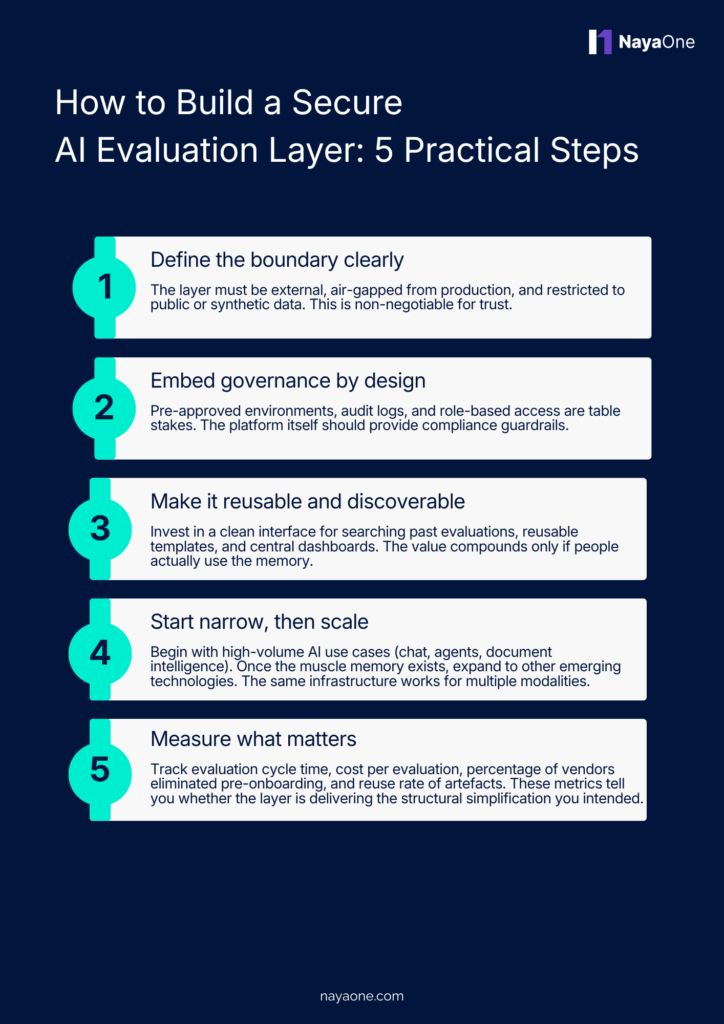
How to Build One (The Pragmatic Path)
The Deeper Principle
The organisations that will thrive in the age of AI are those that build the right infrastructure between ambition and deployment. A secure, standardised evaluation layer is one of the highest-leverage investments you can make today.
It doesn’t just accelerate AI adoption. It makes that adoption safer, cheaper, and far more durable.
The airlock is open. The question is whether your organization will walk through it deliberately – or keep forcing every new idea through the old, narrow gate.
Ready to Build your Secure AI Evaluation Layer?
NayaOne delivers exactly this secure, air-gapped external evaluation platform – purpose-built for enterprises that want to move fast with AI while staying in control.
If you’re tired of 6 – 9 month vendor cycles, duplicated evaluations, and post-onboarding surprises, let’s talk.
Book a 20-minute demo with the NayaOne team →
See for yourself how leading financial institutions are already using NayaOne to test, compare, and de-risk AI vendors before any contract or integration.