
Enterprise AI is often discussed in terms of model cost, infrastructure spend, or licensing.
These are visible costs.
Less visible is the cost of deciding what to use.
In many organisations, the process of evaluating a single vendor involves multiple teams across engineering, security, procurement, legal, and architecture.
Each team contributes necessary oversight.
Collectively, they introduce significant cost.
Evaluation as a Distributed System
Evaluation is rarely owned by a single function.
It is distributed across:
- Engineering teams assessing technical feasibility
- Security teams reviewing risk exposure
- Legal teams reviewing contractual terms
- Procurement teams managing onboarding
- Architecture teams assessing system fit
Each of these activities is rational.
However, because they are not coordinated through a shared system, they operate sequentially rather than in parallel.
This extends both time and cost.
The Fully Loaded Cost of Evaluation
When internal time is accounted for, the cost of evaluating a single AI capability is often substantial.
Engineering time alone can involve multiple weeks of effort.
Security and legal review add additional cycles.
Environment provisioning introduces further delay.
In aggregate, the fully-loaded cost of evaluation can exceed £180,000 to £220,000 per vendor.
This cost is rarely tracked explicitly.
It is absorbed into existing teams and budgets.
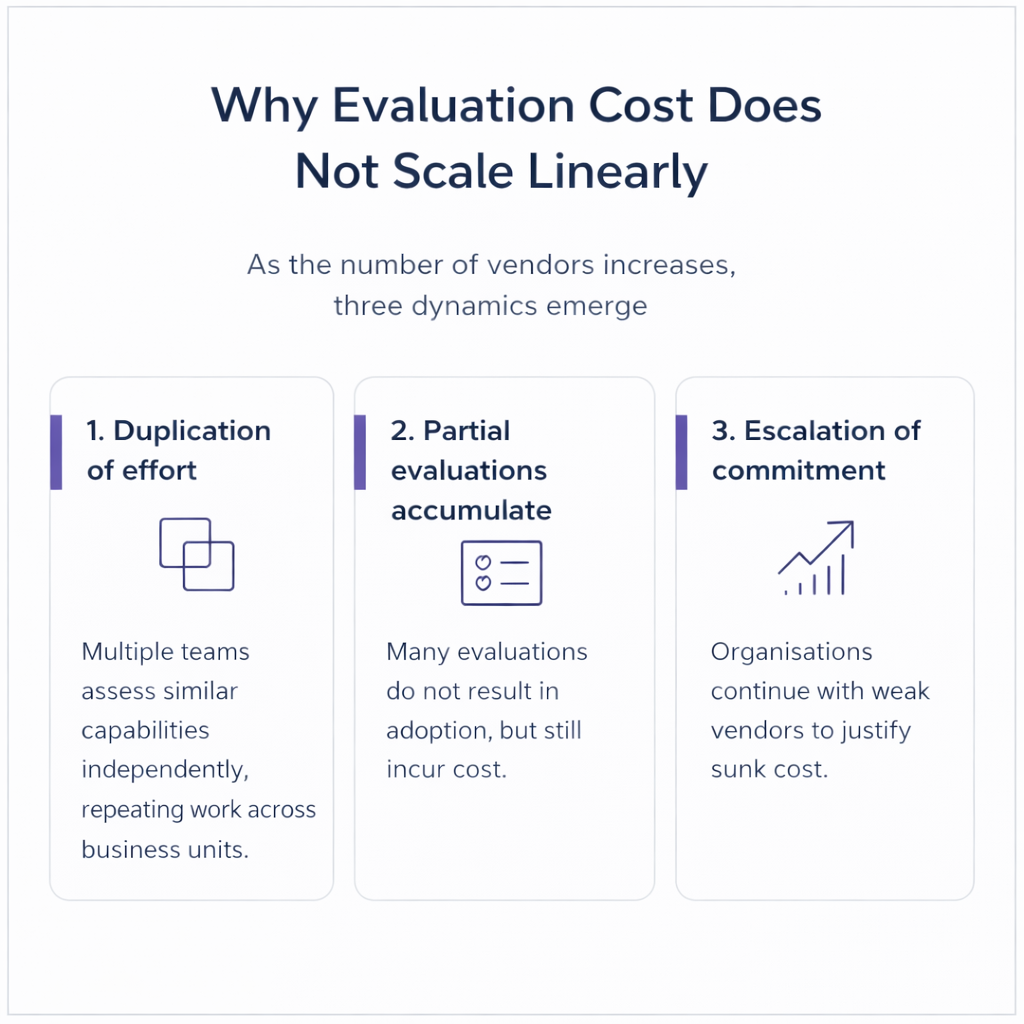
The Compounding Effect
From Evaluation Cost to Decision Quality
The objective of evaluation is not simply to reduce cost.
It is to improve the quality of decisions.
In the absence of structured evaluation systems, organisations face a trade-off:
- Move quickly with limited evidence
- Or move slowly with high coordination cost
Neither outcome is optimal.
A Structural Gap
Most enterprises have well-developed systems for managing:
- Software delivery
- Operational workflows
- Financial processes
However, there is limited infrastructure for managing evaluation as a repeatable, governed activity.
As a result, evaluation remains:
- Expensive
- Inconsistent
- Difficult to audit
Toward Evaluation as Infrastructure
A different approach is to treat evaluation as infrastructure rather than as a series of ad hoc activities.
This would allow organisations to:
- Coordinate evaluation activities across teams
- Reduce duplication of effort
- Capture evidence systematically
- Improve both speed and decision quality
Over time, this shifts evaluation from a hidden cost centre to a controlled, measurable capability.
Implications
As AI ecosystems continue to expand, the number of potential vendors and capabilities will increase.
In this environment, the cost of not having structured evaluation systems will also increase.
Organisations that treat evaluation as infrastructure are likely to:
- Reduce unnecessary spend
- Make more defensible decisions
- Move more quickly from evaluation to production
In practice, this becomes a question not only of efficiency, but of competitive advantage.
→ Learn how NayaOne enables structured, evidence-based technology evaluation.