

There is a growing perception that enterprise AI adoption is accelerating.
Model capabilities are improving quickly. New vendors are entering the market at pace. Most organisations can now identify a wide range of high-value use cases across customer operations, risk, and internal productivity.
And yet, progress from evaluation to production remains uneven.
The constraint is not primarily technical. It is structural.
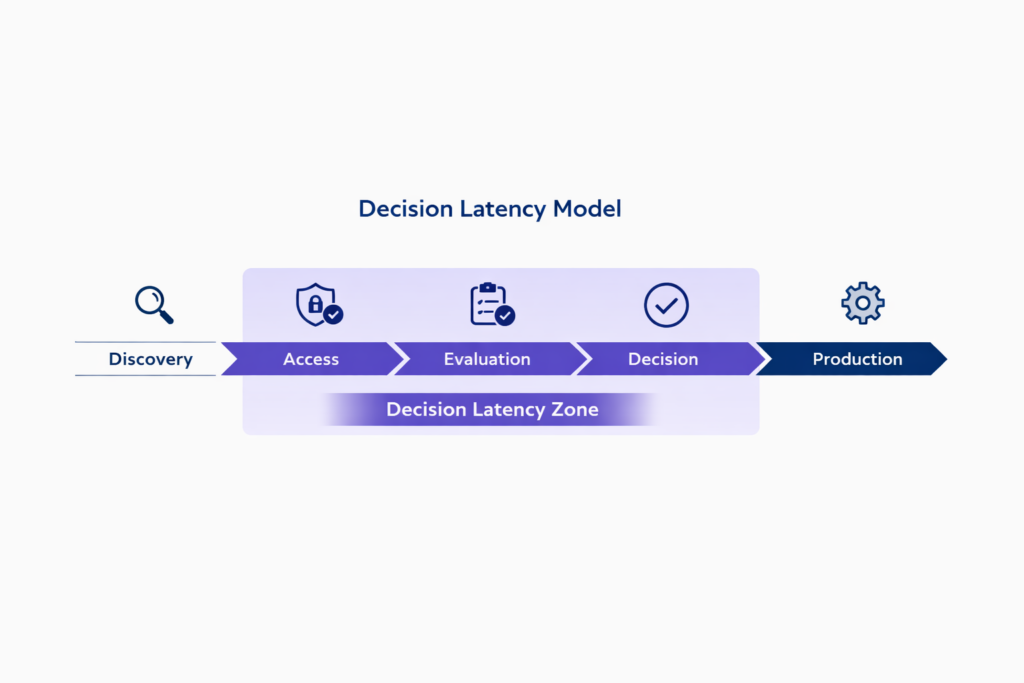
From Capability to Decision
Enterprises are generally effective at recognising opportunity.
They can identify relevant technologies, assess potential use cases, and articulate expected value. In many cases, this happens quickly.
What is slower is the process of turning that recognition into a decision.
Before a new capability can be evaluated in a meaningful way, it must pass through a series of controls:
- Security and risk assessment
- Procurement intake and vendor onboarding
- Legal review of evaluation terms
- Environment provisioning
- Data access and classification approvals
Each of these steps is necessary. Together, they introduce delay between awareness and evaluation.
This delay is often measured in months.
Access Latency as a System Constraint
One component of this delay can be described as access latency: the time required to obtain hands-on access to a new capability within the organisation’s control environment.
When access latency is high, several patterns tend to emerge.
Evaluation activity shifts outside formal systems, as teams experiment with publicly available tools or personal accounts.
Formal proof-of-concepts may prioritise speed over depth, resulting in outcomes that demonstrate plausibility but do not generate sufficient evidence for architectural or procurement decisions.
Organisational learning slows, as the rate of experimentation is constrained by the time required to initiate it.
These effects are not independent. They compound over time.
Naming the Broader Constraint: Decision Latency
Access latency is a local manifestation of a broader issue.
At a system level, enterprises are experiencing decision latency.
They are able to identify technological opportunities quickly, but require significantly more time to evaluate, validate, and commit to those opportunities.
The result is a persistent gap between:
- The pace at which new capabilities emerge
- And the pace at which organisations can responsibly adopt them
This gap is widening.
The Missing Layer: Evaluation Infrastructure
Enterprise systems are typically well-developed in other domains.
There is mature infrastructure for:
- Software delivery
- Operational management
- Financial control
However, there is comparatively little infrastructure for the process that sits between technology discovery and production adoption.
This process, often described as vendor evaluation, remains fragmented. It is distributed across teams, tools, and workflows, and frequently relies on manual coordination.
As a result, decision-making becomes slower, more variable, and more difficult to audit.
In response, a new class of infrastructure is beginning to emerge, designed to standardise how organisations access, test, and validate external technologies before committing to them.
Reducing Decision Latency
Reducing decision latency requires more than process optimisation.
It requires infrastructure that allows organisations to:
- Access new capabilities within controlled environments
- Conduct evaluation against representative conditions
- Generate evidence that can support technical, risk, and commercial decisions
Sandbox environments are one mechanism for achieving this.
When designed appropriately, they do not simply provide a safe space for experimentation. They reduce the time required to move from awareness to evaluation, while preserving governance and control.
More broadly, they contribute to a shift from ad hoc evaluation to structured, repeatable decision-making.
Implications for Enterprise AI Adoption
As AI capabilities continue to evolve, the primary differentiator between organisations is unlikely to be early awareness of new technologies.
It will be the ability to evaluate those technologies efficiently, and to make decisions with confidence.
In this context, decision latency becomes a key constraint on adoption.
Organisations that reduce it are better positioned to translate capability into outcome.
Those that do not may continue to generate insight, without achieving sustained deployment.
→ Learn how NayaOne enables structured, evidence-based technology evaluation.