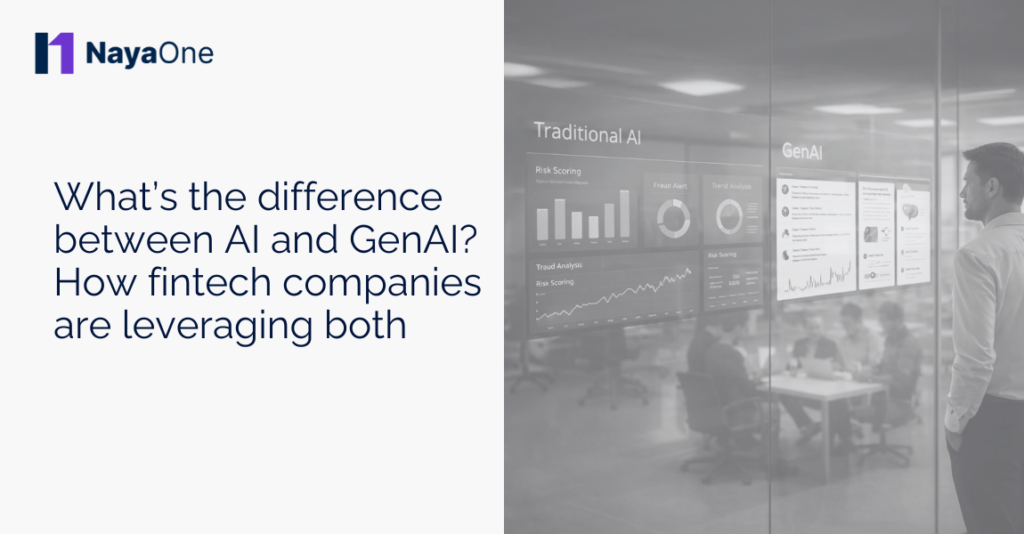
Technology is changing finance fast, and two terms you might hear a lot are AI and GenAI. Both are making waves in fintech, but what’s the difference between AI and GenAI? Understanding this can help fintech companies unlock new opportunities and create smarter, more personalised services that stand out in a crowded market. Already, around 90% of fintech companies are leveraging artificial intelligence to enhance their services, showing just how widespread AI use has become in the sector.
Let’s break it down and see how both are being used to reshape the future of finance, transforming everything from customer service to risk management.
What exactly is AI, and how is it used in fintech?
Artificial intelligence, or AI, refers to machines programmed to perform tasks that usually need human intelligence. This can include recognising patterns, analysing vast datasets, making decisions, or even learning from new information. In fintech, AI is already a staple for things like fraud detection, where it spots suspicious transactions much faster and more accurately than any human could. This ability to analyse huge volumes of transactions in real time helps financial institutions protect customers and prevent losses. But when diving deeper, many ask: What’s the difference between AI and GenAI?
Beyond fraud detection, AI is also used to automate repetitive and time-consuming tasks like processing loan applications or verifying customer identities. These tasks, once slow and prone to human error, can now be completed swiftly and consistently by AI systems. AI also plays a critical role in risk assessment. By crunching through enormous amounts of financial and behavioural data, AI models can predict potential risks and help lenders decide who qualifies for loans with greater confidence. These applications not only improve operational efficiency but also allow fintech companies to reduce costs, offer faster approvals, and provide safer, more reliable financial services.
What is GenAI, and how does it differ from traditional AI?
Generative AI, or GenAI, is a newer and more advanced form of AI that goes beyond analysing and recognising data; it actually creates new content. This content can range from writing human-like text and generating realistic images to even producing functional code or synthesising speech. Many wonder: What’s the difference between AI and GenAI? The main difference between traditional AI and GenAI is that while traditional AI focuses on understanding and analysing existing data, GenAI generates fresh, original output based on patterns it has learned from training data.
In fintech, GenAI is beginning to transform customer experiences in exciting ways. For example, GenAI-powered chatbots can hold far more natural, engaging, and personalised conversations than older AI systems. These chatbots can answer complex questions, assist with financial planning, or even guide customers through complicated processes, making digital interactions feel more human and less robotic. GenAI also helps fintech companies with content creation tasks, such as generating detailed financial reports, summarising market trends, or creating personalised investment recommendations, all in a fraction of the time it would take a human. This not only saves time but also helps make complex information more accessible and easier to understand for customers.
How fintech companies are integrating AI and GenAI for maximum impact
Many fintech firms are discovering the benefits of combining both AI and GenAI technologies to deliver superior products and services. Traditional AI is well-suited for handling large volumes of data-heavy tasks like detecting fraud, managing credit risk, or automating compliance checks, while GenAI enhances customer engagement and communication by offering personalised, conversational interfaces and creative outputs. This raises the important question: What’s the difference between AI and GenAI? Understanding this helps firms use each technology to its fullest potential.
For instance, a fintech app might use AI to continuously monitor transactions and flag any suspicious activity. When a potential issue arises, a GenAI-powered assistant can explain the alert to the user in simple language, offer advice on next steps, or even help resolve the problem directly through conversation. This combination of precise data analysis and personalised communication improves not only security but also customer satisfaction and trust.
Of course, integrating these technologies does come with challenges. Data privacy and security are paramount concerns, especially given the sensitive financial information involved. Additionally, fintech firms must ensure their AI and GenAI systems operate fairly, avoiding biases that could harm certain customer groups. Navigating regulatory requirements is another critical aspect, requiring ongoing vigilance and careful governance. Despite these hurdles, fintech companies that approach AI and GenAI adoption thoughtfully stand to gain significant competitive advantages.
What does the future hold for AI and GenAI in fintech?
Looking ahead, the potential for AI and GenAI in fintech is vast and promising. We can expect to see even more sophisticated fraud detection systems that adapt in real time to emerging threats, reducing financial crime more effectively than ever before. Personalised financial planning will become more accessible, with virtual advisors using GenAI to tailor investment advice and budgeting help based on individual behaviours and goals.
Automation of compliance monitoring and reporting will likely become standard, reducing the burden on human teams while increasing accuracy. As GenAI models continue to improve, we may see virtual financial advisors capable of handling complex, multi-step queries instantly, providing high-quality guidance without human intervention.
Fintech companies that keep pace with these innovations and remain flexible in their strategies will be best placed to thrive. Adapting to ongoing technological change will require continuous learning and investment, but those who succeed will be the ones driving the future of finance.
Why understanding the difference between AI and GenAI matters for fintech leaders
Knowing the difference between AI and GenAI helps fintech leaders make smarter, more strategic decisions about where to focus their resources and innovation efforts. While traditional AI remains critical for analysing data, automating processes, and improving operational efficiency, a GenAI sandbox opens up new possibilities for creativity, customer interaction, and content generation.
By thoughtfully leveraging both, fintech companies can deliver safer, faster, and more personalised financial services that meet the evolving needs of customers. Recognising how these technologies complement each other enables leaders to build solutions that are not only technologically advanced but also user-friendly and trustworthy.
So next time you wonder what’s the difference between AI and GenAI, remember: both are powerful tools reshaping the finance landscape. Using them wisely will be key to unlocking new opportunities and driving success in the fintech space.