

Artificial intelligence is moving quickly.
New models appear every few months.
New vendors appear every few weeks.
From the outside, it can feel like organisations should be adopting these tools almost immediately.
But when you talk to people inside large enterprises, the story looks very different.
Most organisations are experimenting with AI.
Very few are deploying it at scale.
That gap is where the interesting part of the story lives.
Across many organisations, the pattern looks surprisingly consistent.
| Stage | What happens |
|---|---|
| Exploration | Teams experiment with new tools and models |
| Evaluation | Proofs-of-value test feasibility |
| Adoption | Systems enter production workflows |
In many enterprises, most initiatives remain in the first two stages.
The challenge is rarely the capability of the model.
It is the ability of the organisation to evaluate technology quickly enough to make confident decisions.
Adoption Is a Coordination Problem
It’s easy to assume that slow adoption means organisations are unsure about the technology.
In practice, the opposite is often true.
Many enterprises are actively exploring AI.
Innovation teams are building prototypes.
Engineering teams are experimenting with models.
Business units are identifying potential use cases.
But turning those early experiments into operational systems requires something different.
A new AI capability rarely enters an organisation on its own.
It enters through a decision pipeline that involves multiple teams.
| Function | What they usually need to confirm |
|---|---|
| Data teams | How data will be accessed and protected |
| Security teams | Whether the architecture introduces new risk |
| Enterprise architecture | How the system integrates into the existing stack |
| Procurement | Vendor viability and commercial terms |
| Compliance and risk | Regulatory and governance requirements |
Each step exists for a good reason.
Enterprises operate in environments where data protection, operational stability, and regulatory compliance matter deeply.
But when these checks happen sequentially, the process moves much more slowly than the technology itself.
The Missing Infrastructure for Adoption
If you zoom out, something interesting becomes visible.
Most enterprises have built sophisticated infrastructure for running software once it reaches production.
They have systems for:
- building and deploying applications
- monitoring operational systems
- managing financial processes
But the pipeline between “we should evaluate this technology” and “this technology is running in production” is often surprisingly informal.
Spreadsheets track vendor assessments.
Committees review architecture proposals.
Procurement cycles stretch across months.
In other words, organisations have infrastructure for software delivery.
But not for technology adoption.
The Decision Latency Problem
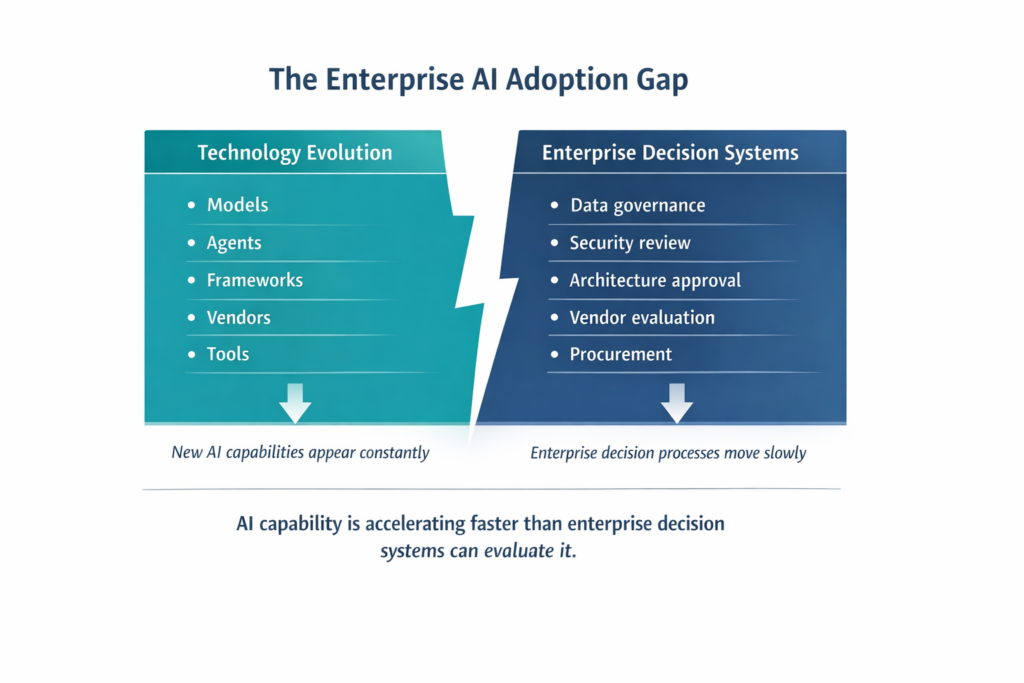
This creates what you could call a decision latency problem.
Technology evolves quickly.
Enterprise decision systems move much more slowly.
And the gap between those two speeds is where many AI initiatives stall.
Why Testing AI Inside Enterprises Is Difficult
In theory, testing a new AI capability should be straightforward.
A team identifies a promising tool, runs a small proof-of-value, and evaluates whether it works.
Inside large enterprises, the reality is usually more complex.
Even small experiments can trigger a series of questions before testing can begin.
| Function | Typical question |
|---|---|
| Data teams | Can the tool access representative data safely? |
| Security teams | Does the architecture introduce new risk? |
| Enterprise architecture | How does the system integrate into the existing platform? |
| Procurement | Is the vendor approved to work with the organisation? |
| Compliance and risk | Does the evaluation meet regulatory requirements? |
None of these checks are unreasonable.
But together they create friction that slows experimentation long before production becomes the issue.
The result is that organisations often evaluate fewer ideas than they intend to.
And when experimentation slows down, learning slows down as well.
The Role of Data and Architecture Teams
For many organisations, AI adoption is less about models and more about data readiness and governance.
Chief Data Officers and enterprise architecture teams increasingly sit at the centre of these decisions.
Their job is not simply enabling experimentation.
It is enabling experimentation safely and repeatedly.
That typically means balancing three competing priorities.
| Priority | Why it matters |
|---|---|
| Access | Teams need environments where they can test ideas |
| Governance | Sensitive data and regulated workflows must remain protected |
| Speed | Innovation cannot wait months for approval cycles |
Getting that balance right is one of the defining challenges of enterprise AI.
The Cost of Slow Technology Decisions
Evaluation delays create more than frustration.
They create cost.
Every additional month spent evaluating technology typically involves:
- engineering time
- architecture reviews
- procurement coordination
- vendor engagement
As evaluation cycles stretch from weeks into months, these costs accumulate quickly.
For many organisations, the real cost of innovation is not failed experiments.
It is the time spent evaluating technologies that never reach production.
Why Speed Matters in Technology Decisions
Speed is not just a convenience in technology adoption.
It directly affects an organisation’s ability to access new capabilities.
Slow evaluation processes delay innovation, increase evaluation costs, and make it harder for teams to test new ideas.
At the same time, speed alone is not enough.
Enterprises also need confidence that the decisions they make are sound.
The goal is not simply faster decisions.
It is the ability to move quickly while making informed decisions.
Organisations that achieve this balance can test more technologies, gather stronger evidence, and avoid committing to solutions that ultimately fail to deliver value.
The Organisations That Learn Fastest Win
If you look at the organisations making the most progress with AI, they usually have something in common.
They have built systems that allow them to evaluate technology more effectively.
They can test ideas, gather evidence, and decide whether something belongs in their architecture.
Over time, those systems compound.
Because in practice, the organisations that learn the fastest are usually the ones that lead their markets.
You can see this pattern clearly in real-world projects, where organisations test and validate emerging technologies before committing to production.
How Leading Enterprises Evaluate Emerging Technology
Many organisations are now introducing structured environments where new technologies can be discovered, tested, and validated before entering production systems.
These environments allow teams to evaluate vendors, test integrations, and gather evidence about performance and risk without exposing live systems or sensitive data.
NayaOne provides the secure infrastructure enterprises use to run these evaluations safely and repeatedly.
→ Learn how NayaOne helps enterprises evaluate AI and emerging technologies.