

A practical guide for CPOs, CTOs, CIOs, and enterprise leaders navigating AI delivery in complex, regulated environments.
Who This Is For
This playbook is for enterprise leaders in financial services who are accountable for turning AI strategy into real-world outcomes. Whether you are a Chief Product Officer, CTO, CIO, CDO, or Head of Innovation, this guide is designed to help you move from scattered pilots to scalable delivery – with governance, infrastructure, and business value built in from day one.
C-Level Summary: What Matters Most
- Most AI projects stall due to fragmented data, slow PoCs, and unclear decision ownership.
- PoCs must be governed from day one, not retrofitted for compliance later.
- Structured delivery infrastructure cuts AI time-to-value by up to 50 percent.
- Treat vendor validation as a repeatable function, not a one-off.
1. Executive Summary
Generative AI has become a strategic priority for financial institutions. Yet despite strong interest, most banks are struggling to move beyond isolated experiments. Projects stall. Decisions drag. Infrastructure falls short.
The issue is not with AI itself. The issue is with enterprise delivery.
This playbook is designed for leaders who are under pressure to deliver. It helps teams move from PoCs to production without compromising control, compliance, or speed. It outlines a structured approach to AI adoption, grounded in five enterprise pillars and a repeatable delivery model.
Why Most AI Projects Stall (McKinsey, 2024)
- 66% fail to deliver measurable value
- 40% never progress past PoC
- Top 3 blockers: data fragmentation, lack of delivery infrastructure, unclear ownership
- Treat vendor validation as a repeatable function, not a one-off.
High-Leverage Question
Are your AI initiatives being designed with delivery and compliance in mind from the start?
2. The Case for AI at Scale
AI is no longer optional. Value is shifting toward enterprises that can embed AI across journeys, operations, and decisions.
Why it matters now
- Customers expect intelligent servicing and hyper-personalisation
- Cost pressure is accelerating automation agendas
- Competitive threats from digital-native players are growing
- Regulators are formalising AI guidance and expectations
Where things go wrong
- Fewer than one in five GenAI initiatives go beyond PoC
- Vendor onboarding typically takes 6 to 9 months
- Many projects fail due to unclear ROI, internal misalignment, or risk concerns
What Good Looks Like
Capability
- PoC Duration
- Use Case Selection
- Governance
- Reuse of Tools/Models
- Vendor Selection
Typical
- 6 – 9 months
- Ad hoc
- Reactive
- Rare
- Demo-based
NayaOne
- 6 – 8 weeks
- Portfolio-mapped
- Embedded at PoC stage
- Systematic
- Pre-validated test results
High-Leverage Question
Can you measure how long it takes your organisation to go from AI idea to value delivered?
3. The Five Pillars of an AI-Ready Enterprise
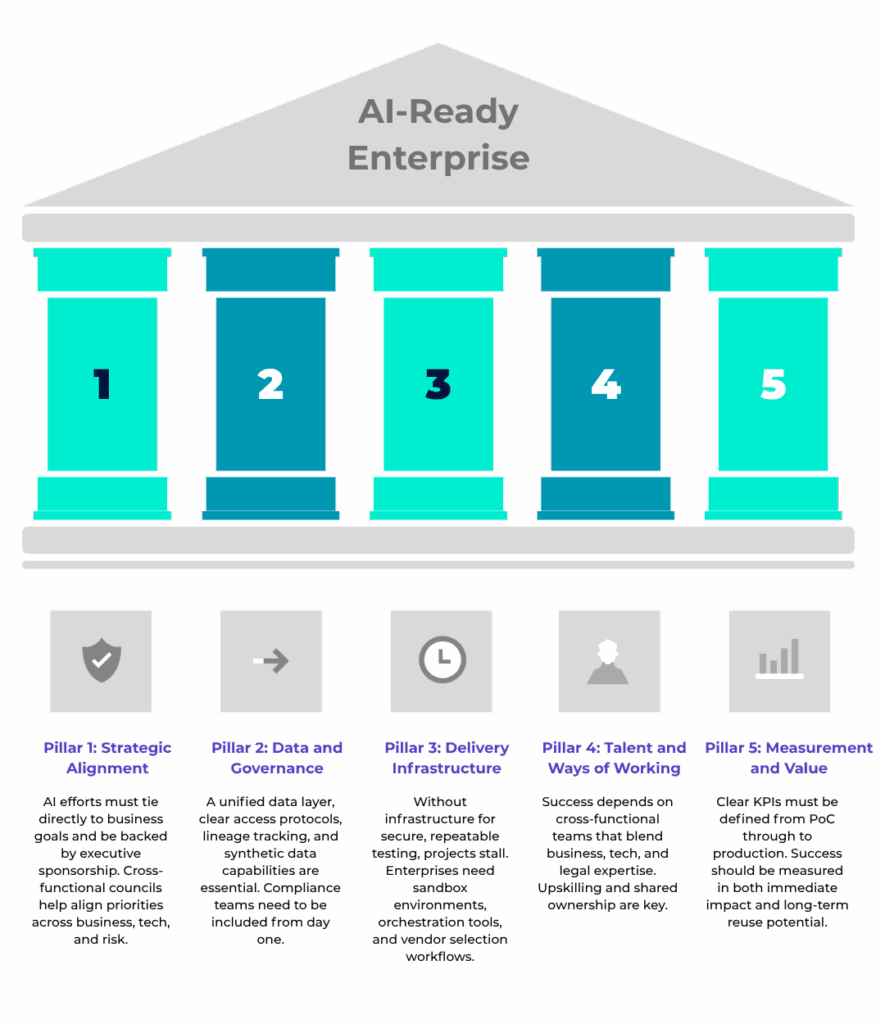
Snapshot: From Typical to Mature
Pillar
- Governance
- Data Access
- Teams
- Metrics
Immature State
- Added post-PoC
- Manual, risky
- Siloed
- None or vanity
Mature State
- 6 – 8 weeks
- Controlled, traceable
- Cross-functional
- Linked to value and reuse
Maturity Indicators
Indicator
- Exec sponsor owns use case outcomes
- Reusable vendor and data workflows exist
- Legal and compliance review starts pre-PoC
In place?
- Write here
- Write here
- Write here
4. Use Case Portfolio Strategy
Every enterprise has hundreds of AI ideas. The challenge is prioritising what to do first.
Prioritisation criteria
- Strategic fit with business objectives
- Data readiness or synthetic data availability
- Regulatory exposure and control requirements
- Reusability across multiple teams or functions
Example matrix
Impact
High
High
Medium
Low
Feasibility
High
Medium
High
Low
Examples
- Document automation, fraud triage
- AI agents, personalised cross-sell
- Customer sentiment classification
- Experimental chatbot pilots
Use Case Readiness Checklist
Item
- Has a business owner
- Mapped to strategic goals
- Known data sources available
- Regulatory implications identified
- Success metrics agreed
In place?
- Write here
- Write here
- Write here
- Write here
- Write here
5. From Idea to Deployment: A Repeatable Framework
A structured delivery process helps prevent delays and reduces risk.
Step 1: Identify
Map strategic priorities to use cases. Align stakeholders and define what success looks like.
Step 2: Validate
Source vendors. Test safely in a sandbox with synthetic or production-like data. Use standardised evaluation criteria.
Step 3: Decide
Run build-buy-partner analysis. Finalise decision with procurement and risk teams.
Step 4: Scale
Plan integration. Reuse infrastructure, data flows, and documentation. Create shared playbooks for future teams.
Miniature Example
A large bank validated three GenAI vendors in parallel within a shared sandbox, reducing time-to-decision from five months to six weeks.
6. Governance, Risk, and Compliance
Compliance is not the barrier. Lack of coordination is.
Key enablers
- Alignment with NIST AI Risk Management Framework
- Role-based access, monitoring, and audit logging
- Risk-first evaluation environments
- Explainability and fairness checks built into the PoC process
- Synthetic data to test without customer exposure
Governance by Design Checklist
Item
- Compliance reviewed evaluation protocols pre-launch
- Data used is explainable and traceable
- Audit trail created during PoC
In place?
- Write here
- Write here
- Write here
High-Leverage Question
When does your legal team first see the AI use case?
7. Accelerators and Enablers
Enterprise teams do not need to build from scratch. Speed comes from reuse.
What accelerates delivery
- Secure infrastructure for evaluation and validation
- Curated marketplace of pre-integrated AI vendors
- Pre-built synthetic data sets
- Embedded governance workflows
- Procurement templates and documentation libraries
Cliff Note
Standardised vendor workflows and reusable PoC templates reduce time-to-first-value by 40 to 60 percent.
8. AI Maturity Model
Use this to benchmark your organisation’s current state.
Level
- 1
- 2
- 3
- 4
- 5
Description
- Exploring - Pilots in isolation, no shared infra
- Experimenting - Scattered PoCs, limited governance
- Structuring - Dedicated environments and reuse patterns forming
- Scaling - Repeatable delivery, vendor strategy aligned
- Institutionalised - AI embedded in core operations and planning
Are You Scaling? Checklist
Item
- Governance embedded at PoC stage
- Repeatable PoC delivery model exists
- AI adoption tied to business KPIs
In place?
- Write here
- Write here
- Write here
9. In Practice: The Playbook in Action
Example: A North American bank wanted to streamline SME onboarding using AI.
- Document automation was identified as a priority use case across three units
- Teams shortlisted vendors and ran structured evaluation in a secure environment
- The PoC validated accuracy, explainability, and compliance alignment
- Vendor onboarding time dropped from seven months to six weeks
- The solution is now being scaled across additional business lines
10. What to Do Next
AI adoption should not be reactive. It must be structured. Start by:
- Running a maturity review across the five pillars
- Prioritising two or three use cases that are ready for validation
- Launching a structured PoC process with compliance embedded
How NayaOne Helps
NayaOne is the Vendor Delivery Infrastructure used by leading banks and insurers to accelerate AI adoption. The platform provides secure PoC environments, synthetic data libraries, and access to pre-integrated vendors. It enables teams to validate, de-risk, and scale AI capabilities without losing control or momentum.
Ready to move from pilots to production?
If you’re building AI into your roadmap but stuck in slow PoCs, misaligned decisions, or compliance deadlock, now is the time to reset your delivery model.
We’re helping enterprise teams shorten vendor validation cycles, embed governance from day one, and get AI-enabled journeys live without losing control.
Let’s explore where you are today — and what it would take to accelerate.